
Pons V2 Robinhood Launch
Launch a Robinhood Chain token on the Pons V2 native bonding curve with an atomic launch bundle, optional creator tax, protocol buyback mode, holder cleanup, and starter strategies.

Sumo supports Robinhood Pons V2 launches on Robinhood Chain. Pons V2 is a native-quote bonding curve rather than a pool launch: the token trades against the curve in ETH from the first block, and graduates to a Pons V4 pool once the curve reaches its threshold. Sumo plans the ordered curve buys with the same integer curve math the backend planner uses, simulates them, and submits creation plus every launch buy as one atomic bundle.
Prerequisites
Before launching, make sure you have:
- Token metadata ready: name, ticker, image, description, and social links
- ETH on Robinhood Chain for the ordered curve buys, the Pons launch fee, the creator gas reserve, and per-wallet cleanup buffers
- A launch plan: supply control target, optional dev buy, creator tax, bundle wallet count, and holder cleanup preference
- A wallet plan: use ready wallets from private keys, Wallet Farm, or another profile, or create new Robinhood Chain wallets / buy aged EVM wallets through Wallet Marketplace during the wizard
Fixed Pons V2 Parameters
The current Pons native launch config fixes total supply at 1 billion tokens with 18 decimals and ETH as the quote asset. Total supply and decimals are set automatically when you choose the launchpad and are not edited in the standard Sumo flow.
Launch Flow
1. Info
Choose Robinhood Pons V2 in the Launchpad field, then enter the token and profile details.
| Field | Required | Description |
|---|---|---|
| Launchpad | Yes | Select Robinhood Pons V2. The launchpad is locked after the draft is saved. |
| Profile Name | Yes | Internal Sumo profile name used after launch |
| Token Name | Yes | Public token name |
| Ticker | Yes | Public token symbol, auto-uppercased |
| Image | Yes | JPG or PNG image, up to 2 MB |
| Description | No | Public token description |
| X, Telegram, Website | No | Public social links attached to the profile |
2. Buy Mode
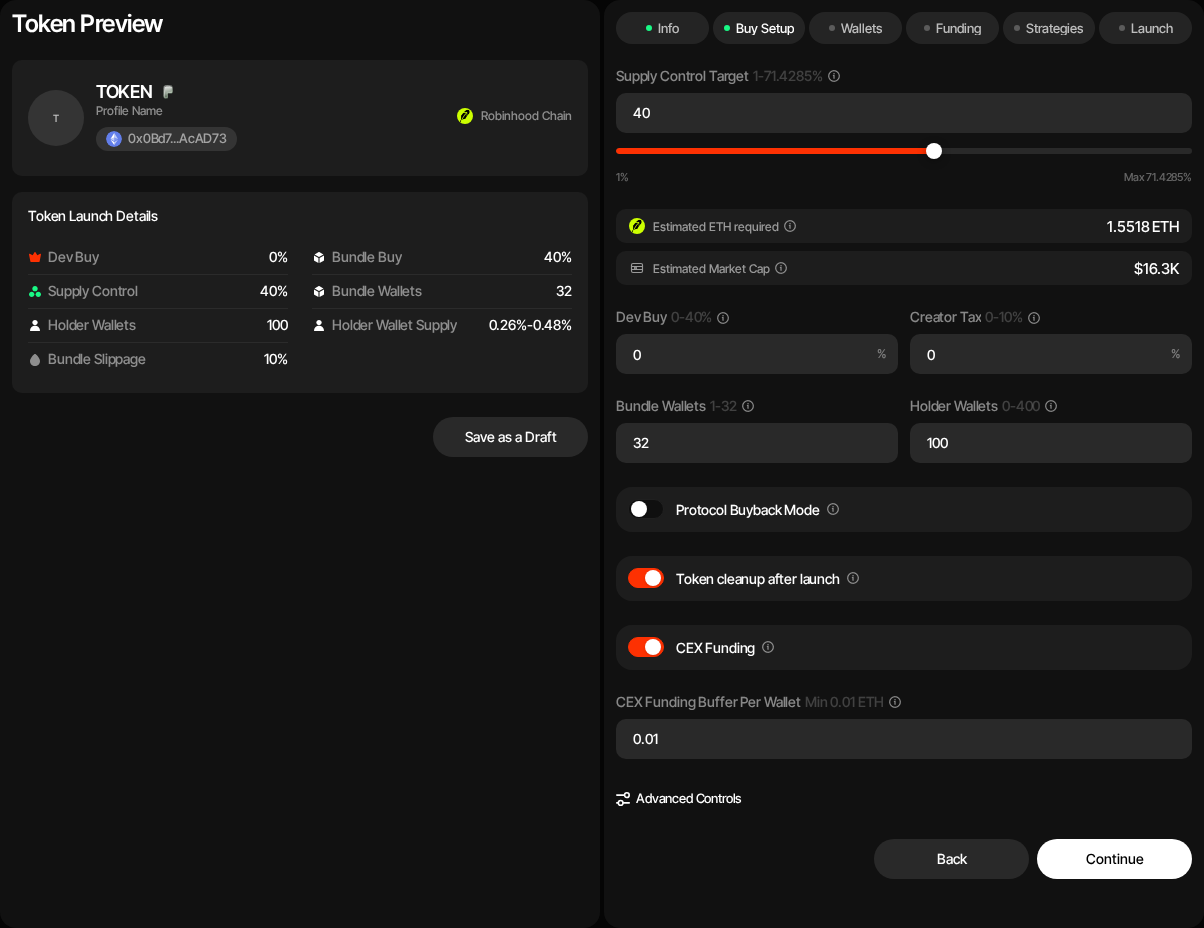
Pons V2 buy planning runs against the native bonding curve. Two modes are available:
- Bundle keeps the curve active after launch. The dev buy and the bundle wallets control up to 71.4285% of supply.
- Graduation Bundle buys out the whole curve inside the launch transaction, graduates the token to its Uniswap V4 pool, and keeps buying from that pool with separate Post-Graduation Wallets, all atomically. The dev buy and the bundle wallets always control exactly 71.4285%; everything above that is the Post-Graduation Buy, split across the post-graduation wallets. The target can run up to the protocol ceiling of 91.8367% (the curve plus the tokens the factory seeds into the pool), although the pool's constant-product pricing makes the last fraction of a percent prohibitively expensive and the planner reports targets it cannot fill.
| Setting | Description |
|---|---|
| Quote Asset | The asset the bonding curve is priced in: ETH, or any pair token the Pons factory has approved: the Robinhood stock tokens (TSLA, NVDA, AAPL, and the rest), the SPY, QQQ, GLD, and USO ETFs, cbBTC, and USDG. The picker groups them by kind and is searchable by ticker, name, or address. Each stock quote carries its own curve economics, so the estimates re-read the live terms when you change it. Both modes accept a stock quote: a Graduation Bundle then graduates into a pool paired with that asset, and its Post-Graduation Wallets buy from the pool in it. |
| Supply Control Target | Total supply controlled by the creator, bundle buys, and (in Graduation Bundle) post-graduation buys. Bundle: 1% to 71.4285%, the highest value that stays below the reviewed config's sellable-supply limit; hitting the cap is flagged as Curve max in the estimate row. Graduation Bundle: from 71.4285% plus 0.01% per post-graduation wallet up to 91.8367%, flagged Beyond curve. |
| Estimated ETH Required | Ordered curve buys, post-graduation pool buys when applicable, plus the live Pons launch fee, creator gas reserve, and configured per-wallet cleanup buffers. On a stock quote this is the ETH the funding swap will spend (the quote total at the live aggregator rate the swap itself executes on, plus a 5% margin and a 0.01 ETH gas allowance per swapping wallet; the swap itself sizes each wallet at its need divided by one minus the slippage and executes with the need as the minimum output, so a landed swap always covers the wallet) plus the ETH-denominated fee, gas, and buffers, and a second row shows the quote total itself. The 5% margin is only the funding target: a wallet reads as funded once it holds the swap's own sizing plus its reserve, so a small rate move after funding does not flag it, and a wallet that does fall under that bar is topped back up to the full target. Once the swap preview has sized the run, its exact per-wallet requirement (at the slippage chosen there) becomes that bar, so any wallet the preview flags reads short in the table and Fund ETH offers exactly the top-up the swap needs. If no aggregator can quote the pair the ETH column shows as unavailable and the swap stays disabled until it can. |
| Estimated Market Cap | Projected post-bundle spot price from the same integer curve math used by the backend planner (or the seeded pool's price after the post-graduation buys), multiplied by the fixed one-billion-token supply. |
| Dev Buy | Optional dev-wallet buy before the bundle, always on the curve. Set to 0 for no dev buy. In Graduation Bundle it is capped so every bundle wallet keeps at least 0.01% of the curve. |
| Post-Graduation Buy | Graduation Bundle only. Read-only: the target minus the 71.4285% curve, bought from the Uniswap V4 pool. |
| Post-Graduation Wallets | Graduation Bundle only. Number of wallets that buy from the pool after graduation, 1 to 32. They are separate from the bundle wallets. |
| Creator Tax | Optional fee on every Pons buy and sell, 0% to 10%. Token transfers are not taxed. |
| Bundle Wallets | Number of launch-exempt external buyers. Pons supports at most 32. The optional dev buy is separate and does not consume one of these slots. |
| Injection Wallets | Optional extra wallets, up to 100, funded with ETH for activity after launch. They do not buy in the launch or take part in cleanup. |
| Funds Per Injection Wallet | Shown when Injection Wallets is above 0. ETH sent to each injection wallet during funding. Defaults to 0. |
| Holder Wallets | Post-launch destinations for transfer or Pons V2 sell/buy token cleanup. Up to 400. With Token Cleanup Method Off the wallets are still created, but nothing funds or fills them, and the per-bundle-wallet limits do not apply. |
| Protocol Buyback Mode | Uses part of the creator fees to buy back and vest the token. |
| Holder Fee Sharing | After activation, deploys the token's Pons holder-fee distributor and hands it the creator-fee recipient, so creator fees and creator tax are shared pro-rata with holders, who claim on Pons. Permanent: fees cannot be routed back. The workflow card shows the distributor once routed; if the handoff fails, the launch still completes and the card offers Retry holder fee routing, which only redoes the steps that have not landed. |
| Token Cleanup Method | Off, Token Transfer, or Sell / Buy. Redistributes bundle-wallet tokens to fresh holder wallets after launch confirmation, by direct transfer or by sells and buys through the shared Pons V2 cleanup route. |
| CEX Funding | Funds the Pons launch wallets with ordinary Robinhood Chain ETH cashouts using the standard CEX funding flow. |
| CEX Funding Buffer Per Wallet | Extra ETH included in the CEX cashout budget for each launch wallet. |
| Advanced Controls | Bundle supply jitter, bundle slippage, creator gas reserve, funding buffer per wallet, cleanup delay, and holder supply jitter. |
32 Bundle Wallets Is a Protocol Limit
The 32-wallet cap is the Pons factory exemption-list limit, not a Sumo batching choice. Only wallets on that list can buy before public trading opens, so the bundle cannot be widened by splitting it across more transactions.
3. Wallets
Add, import, or generate wallets for each required Robinhood Chain role.
| Role | Description |
|---|---|
| Dev Wallet | The creator. Deploys the token and curve, performs the optional dev buy, and pays launch and cleanup gas. |
| Bundle Wallets | The launch-exempt buyers that execute ordered curve buys inside the atomic bundle. |
| Injection Wallets | Optional wallets funded with ETH for activity after launch. They take no part in the launch or cleanup. |
| Post-Graduation Wallets | Graduation Bundle only. Buy from the Uniswap V4 pool after the curve is bought out, in the same transaction. Like bundle wallets they are active project wallets from launch and are cleanup sources when token cleanup is enabled. |
| Holder Wallets | Receive tokens through post-launch cleanup when token cleanup is enabled. With Token Cleanup Method Off they are still created and stay empty. |
You can use ready wallets, create new wallets, or buy aged wallets at this step. Ready-wallet paths include importing private keys, pulling wallets from Wallet Farm, or reusing wallets from another profile. Additional paths include creating new wallets or buying aged inventory from Wallet Marketplace.
Pons V2 launch tokens have no tax wallet - the optional creator tax is collected by the protocol against the creator, not routed to a separate role wallet. Freeze and sniper wallets are not used.
4. Funding
Save the draft before funding. If CEX funding is enabled, deposit the estimated Robinhood Chain ETH into the funding wallet, check the balance, then use Fund to distribute ETH. If CEX funding is disabled, fund the dev and bundle wallets directly and use Check Balances.
On a stock quote every wallet is still funded in ETH first. Once every wallet holds at least the swap's own ETH sizing (the funding table shows a wallet's balance in red until it does), Swap ETH to <QUOTE> opens a preview of the swap: the live rate and provider, each wallet's quote shortfall, the ETH it will spend and keep, and an adjustable slippage (2% by default). Confirming asks SUMO to swap, per wallet, the ETH its remaining quote shortfall needs (at the best aggregator rate, sized so a fill at the slippage floor still covers the need) into the quote token; wallets that already hold their quote are skipped, and a draft whose wallets are all covered reports that nothing is left to swap. The button stays available after every wallet is covered, so you can enter an amount in the preview to buy extra quote for the chosen wallets. The preview also has a <QUOTE> → ETH direction that swaps quote back into ETH. Its Amount to return control sells either what the wallets hold above their planned buys (the default, so the launch stays funded) or everything, for instance to change the quote token and re-import the wallets into a new launch; at most the sellable total, split across the chosen wallets, with each selling wallet paying for its own approval and swap out of its ETH. The two directions never run at the same time. The creator keeps ETH for the launch fee and gas and receives quote for the optional dev buy, and every wallet must keep a 0.01 ETH gas allowance after its swap. The request is rejected up front if any wallet cannot cover its share, and while a swap is still executing a second one is refused. The swaps then land wallet by wallet, so a wallet whose swap fails on-chain keeps its ETH: Check Balances shows the shortfall and the swap can simply be run again for what is missing. Small leftover quote balances after launch are expected.
The funding table supports address copying, allocation randomization, per-wallet allocation edits, and balance checks.
5. Strategies
Optionally add starter strategies to the profile before launch. You can configure Counter Trade, DCA, and Limit Order strategies by hand, or apply a strategy preset: Sumo ships built-in Hyped, Standard, and Staircase presets, and your org can save its own presets for reuse across launches and imports. Strategies are saved with the draft and can be reviewed after the token is live.
6. Launch Preview
The preview summarizes supply control, dev buy, bundle buy, estimated ETH required, estimated market cap, creator tax, and whether protocol buyback mode is enabled.
There is no separate deploy or pool-creation step. Two actions are available:
- Simulate Launch - Plans the ordered curve buys and reports any blockers before funds move.
- Launch Bundle - Hands the launch to the durable runner, which submits the atomic bundle, reads the launch receipt, runs token cleanup when enabled, and activates the profile.
While the runner owns the workflow the action card reports its state: Launch admitted, Submitting atomic bundle, Bundle included, Reading launch receipt, Activating project, and finally Launch complete. Once reconciled, the card also shows the token and curve addresses.
After Launch
When the bundle lands and reconciliation completes, the profile becomes active and opens in Live Trading. The Pons V2 workflow card continues to track curve progress after launch:
| Metric | Description |
|---|---|
| Spot Price | Current curve spot price in ETH. |
| Graduation | Progress toward the curve's graduation threshold, as a percentage. |
At graduation the curve migrates to a Pons V4 pool. Migration is automatic, but if pool creation does not complete, the workflow card exposes a Retry V4 Pool Creation action to submit it manually.
A Graduation Bundle launch lands already graduated: the profile activates directly on the Uniswap V4 pool, the workflow card shows the pool instead of curve progress, and no migration step remains.
Launch Logs
Pons V2 profiles add a Launch Logs tab for plan simulation, bundle submission, receipt reconciliation, holder cleanup, and V4 pool migration.
Creator Fee Claims
Pons pays the creator a share of every trade fee (per the Pons protocol, 70% of the 1% curve and hook fee) plus the whole creator tax, credited to the launch's creator-fee recipient in the Pons fee escrow. Fees arrive in the asset the trade was quoted in — ETH on a native launch, the pair token on a stock pair — and, after graduation, sometimes in the launched token itself. Pons sweeps them into the escrow on its own schedule; only swept fees can be claimed.
Pons profiles expose Claim creator fees in the profile wallet toolbar. The claim reads the recipient from the Pons factory on-chain, so it works for tokens launched on Sumo and for imported Pons tokens still trading on their curve alike, as long as that recipient wallet belongs to the profile (archived launch wallets included). One click claims every non-zero balance, one transaction per asset from that wallet in order, each recorded on its own; the wallet pays only the gas and the fees land in it in full, with no platform cut. The same action is available in Telegram groups through /fees and /claim.
Claims appear in Treasury Logs as Creator Fee Claim entries with the transaction details. A launch with Holder Fee Sharing has no creator fees to claim: they belong to holders, and /fees says so.
Holder reward claims
Holder rewards cannot currently be claimed through the Sumo interface because Pons's reward data service is unreliable.
Further Reading
- What Are Memecoin Bonding Curves? — this launchpad's curve overlaid on every other supported launchpad, with graduation math
- How Much Does It Cost to Launch a Memecoin? — simulate launch cost, starting market cap, and supply held for this launchpad
SushiSwap Robinhood Launch
Launch a Robinhood Chain token through the SushiSwap Launchpad with a single creator transaction, ETH-denominated bundle commitments, holder cleanup, and starter strategies.
Flap Robinhood Launch
Launch a Robinhood Chain token through Flap with ETH or a tokenized stock quote, Bundle or Graduation Bundle mode, Tax V3 or standard token kind, a selectable migration DEX, holder cleanup, and starter strategies.